
Tuesday, March 17, 2015
Repo! The Genetic Opera

Tuesday, March 10, 2015
Mass Effect 3: Special Edition

Many people complained about the ending of the game, but I don't have a problem with it. At the end, the player is presented with a choice. I won't go into too much detail about what those choices were, but I can tell you that they left me feeling conflicted. Essentially you are forced to settle an argument that is made throughout the entire game, and the side that feels the most "right" is one that you have been fighting against for the entire journey. In the game's final moments you decide the fate of yourself, Earth, and future civilizations. Heavy stuff.
You can tell that Bioware spent a great amount of time developing the background for each galaxy, each planet, and each alien race (they even went as far as talking about the diets of certain races). This brainstorming into the Mass Effect universe showed through in the artistic detail of each alien species.
The graphics for Mass Effect 3 were as expected, good but not great, and I'm okay with that. My experience isn't ruined by a few large pixels. I know the Wii U trails other major consoles when it comes to graphic performance. I am now convinced that the console makes up for what it lacks in the graphics department with the new technology of the Gamepad.
I chose to buy the special edition and play the game on Wii U to see how the game had been adapted for different technology. Mass Effect 3: Special Edition uses the Wii U Gamepad as the player's omni tool: a digital multi-tool that lets the player control NPCs on the battlefield and see incoming threats. At first I was skeptical of buying the game in this format. I feared that I may get a "diet" version of Mass Effect 3 that had to remove key features in order to support this technology. The truth was exactly the opposite. The Gamepad enhances the battlefield experiences and I found myself relying on the omni tool in crunch situations. In fact I would panic at times when my tool would lose signal or go offline (certain points in the story made it believable that your map should be offline i.e. while underground or after an EMP). The story does an excellent job of describing the omni tool as well. Instead of giving the player an added sense of awareness without explanation, (like a minimap) the omni tool is presented as a perk of being in the alliance military.
I no longer see the Wii U as a console that can't handle the modern game as well as other consoles, but as one that can take that game and expand upon it. I look forward to exploring this further with Deus Ex: Human Revolution Director's Cut.
Sunday, March 8, 2015
How I Met Your Mother

I particularly enjoyed the glimpses into future seasons. By laying the ground work for future events, it never felt like there was a lull in the show. You are always looking forward to how the story progresses toward the next big event. Other shows like Lost and Supernatural have episodes that do not add any value to the plot and seem to serve as a desperate means to stretch the show for another season. By the time the end of that show comes around, you feel like it has skipped out on what originally made it intriguing. But you can't sacrifice all that time you invested without seeing the end, right? How I Met Your Mother was not like this, and seemed well thought out from the beginning with the end in mind.
Even though the story and character arcs progressed nicely, I never did like Lily very much. For some reason the kleptomania, catch phrases, inability to keep a secret, lesbian fantasies, frequent crying, and very poor decision making skills added up to a character that was more annoying than quirky. To be fair, it was not just Lily who was annoying. Every character got under my skin at one point or another, especially after watching multiple episodes in a row. I do give the writers credit for character consistency through all nine seasons. Halfway through the show you are able to predict how characters will react to situations because you are in tune with their personalities. That may be why it's sad when the characters move on with their lives and the show finally comes to an end.
Despite being a comedy with ample moments of ridiculousness, the show comes to a very sobering end. Ted works so hard to find the love of his life, and in the end only gets her for a few years before she passes away. The entire last season takes place at Barney and Robin's wedding and they end up getting divorced shortly thereafter. Barney goes back to giving up on love and starts shamelessly hitting on girls who are half his age. He does ultimately find meaning in the daughter he has from one of his escapades. Lily and Marshall ultimately recover from their spat and grow old together. I guess every character does find happiness, but not without taking some bruises first. The show actually models life pretty well. You live, you love, and you get old fast. How I Met Your Mother teaches us that life is short, and you have to enjoy every moment.
Tuesday, March 3, 2015
Birdman
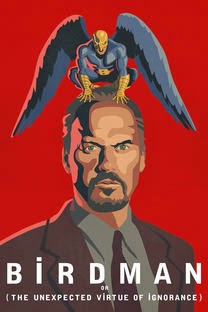
I am still contemplating all the points this movie touched on more than a week after watching it. One of the main points being that today's movie industry is neither deep nor diverse. Alejandro González Iñárritu, the director of Birdman, argues the following: what makes a "successful" movie does not necessarily make a great work of art. I agree with Alejandro's point of view, however not to the same extreme. I will agree that Hollywood has identified a formula for raking in massive amounts of cash: spend lots of money hiring big name actors and adding special effects, add in the standard plot of good versus evil, and leave room for sequel after sequel. The use of this formula does make me upset sometimes, however I am not enraged. This is the way of the world. Not everyone who goes to see a movie is basing its quality off of its contributions to the world of art. The point is to be entertained, and some people find entertainment in watching things blow up for 2+ hours! I could see how it would be upsetting for an actor to make less money than someone who is less talented than you because of their participation in the standard Hollywood formula, however that is your choice. You are not a victim in this scenario, you may be a "purist" or a "real artist," but not a victim.
I also do not believe the use of special effects cheapens a movie's quality or appeal. If time in a movie is not spent on a close up of a character's facial expressions or dialogue, and is instead used to show a beautiful CG landscape that could not be achieved (or would be very difficult to achieve) through traditional filming, then that is just showcasing the talents of other artists instead of the actors. The people behind the explosions and sci-fi worlds in film are artists. They are 3D environment masters, programmers, and special effects teams. These scenes they create take direction and storyboarding to achieve, much like traditional film making. Arguing against this feels to me like an old person refusing to learn how to use email or a smart phone because these things are part of the problem with today's lazy youth.
My apologies for the rant. I found Birdman to be a great movie that makes its audience think, and I wouldn't be surprised if the continuous shot technique started showing up in more movies. The actors, writers, and directors in this movie worked for much less money than the average box office hit, and it paid off (9 Academy Award nominations and 4 Academy Awards). Birdman and Alejandro González Iñárritu sure did get a lot of praise from the industry it criticizes so much, perhaps adding another level of comedy to the movie.
Monday, February 23, 2015
The Visual Story by Bruce Block

For me The Visual Story has done two things 1) given me a concise formula for approaching visual design pieces, and 2) made me appreciate the incredible amount of skill that goes into directing visual art. It was very rewarding for me to read this book during the Academy Award season, where the world's best visual artists showcase their work for everyone to see. I look forward to watching many of the nominated films (Birdman, The Grand Budapest Hotel, The Theory of Everything, The Imitation Game, and Selma) in the coming weeks and analyzing them using Bruce's visual components.
It's easy to skim through The Visual Story as it is less than 300 pages and contains many pictures and diagrams, however it is a book that is best digested slowly. Take some time between chapters and look for examples of what Bruce describes out in the world. You will begin to see things differently, and possibly come away with a better understanding of yourself as a result.
Monday, February 9, 2015
Zapp! The Lightning of Empowerment by William C. Byham
 Zapp! is about a fictional company in a fictional town. The Normal Company in Normalburg, USA manufactures Normalators. Things aren't looking great for the Normal Company. Profit and performance are poor and employee morale is at an all time low. Ralph Rosco, a particularly disgruntled employee in department N, has a brilliant idea for a new product. Ralph uses parts from old Normalators to build his invention, the Ralpholator. The Ralpholator transports users to the 12th dimension where they can see the physical manifestation of a person's energy and feelings. In the 12th dimension you are able to see if people are getting zapped with positive energy or if their energy is being sapped out of them.
Right away Ralph notices the energy sapping decay that the Normal Company is in. As Ralph is wandering the 12th dimension he sees all kinds of unspoken flaws of the Normal Company. There is only one place that is operating effectively, department Z. Ralph studies department Z and notices that the department supervisor, Lucy Storm, practices 5 key principals to energize her employees. These five key principals used in Zapp! are:
- Maintain or enhance self-esteem
- Listen and respond with empathy
- Share thoughts, feelings, and rationale
- Ask for help and encourage involvement
- Provide support without removing responsibility for action
Ralph brings this discovery to the attention of his supervisor, Joe Mode, who learns to use the key principals over time. Lucy Storm, Joe Mode, and Ralph Rosco then team up to transform the whole company using the successes of departments N and Z as models.
Although Zapp! is an abstract and humorous story, its application to everyday life is fantastically obvious thanks to characters Joe Mode and Lucy Storm. Lucy is the star supervisor who sets the example for other departments. Joe is a distrusting supervisor who usually does not consider his employees when making decisions. Joe tries to implement the key principals lazily and hastily at first which ends up sapping employees more than if they had not been implemented at all.
Zapp! is a fun short read that would probably take most readers 3 hours or less, but the key principals mentioned in the book are deep in value. It will be fun and challenging implementing them in my next design project.
Monday, February 2, 2015
Understanding Video Games, University of Alberta

Subscribe to:
Posts (Atom)