Sunday, April 24, 2016

Harness Hero

Falls are the leading cause of death among construction workers in the United States. To protect workers, employers must not only provide the right protective equipment but must ensure workers understand proper setup and safe use of that equipment.

Harness Hero the video game engages players in the key decisions of using a fall arrest system. At each step in the game, the player chooses where to anchor, what anchorage device to use, how to set up the harness, what connection device to use, and so on. The player also inspects the equipment along the way for burns, rips, rust and other malfunctions. At the end of each play, the player encounters a fall, and depending on how well they did setting up their fall arrest system, the player will either witness a rescue or a severe injury or even a fatality. Harness Hero was developed under the guidance of safety professionals from all corners of the construction industry.

Start practicing proper fall arrest setup in a fun and safe way. For more information on the development of the Harness Hero video game, visit: http://www.simcoachgames.com/harness-hero

For more information on fall prevention, visit: https://www.osha.gov/stopfalls/index.html

iTunes: https://itunes.apple.com/us/app/harness-hero/id1103764196?mt=8
Google Play: https://play.google.com/store/apps/details?id=com.simcoachgames.fallprotection&hl=en
Amazon Marketplace: http://www.amazon.com/Simcoach-Games-Harness-Hero/dp/B01EBB9K5O

Sunday, November 15, 2015

Introduction to Software Product Management, University of Alberta


This was the first course of the Software Product Management specialization on Coursera. The specialization is made up of five classes and a capstone project. There wasn't much to this first course, just an overview of the specialization. Looking forward to the next course, Software Processes and Agile Practices.

Saturday, October 17, 2015

Fundamentals of Project Planning and Management, University of Virginia

The following is a small excerpt from the course description of Fundamentals of Project Planning and Management by the University of Virginia:

"Fundamentals of Project Planning and Management will introduce basic concepts from project planning, critical path method, network analysis, and simulation for project risk analysis. You will gain an appreciation for what is required in planning and executing large-scale projects and gain an understanding of Agile Project Management principles. Together, we will develop an awareness of some behavioral biases that come to play in project settings and identify how these impact the planning and execution of a project."


For me the class was helpful in learning how to articulate the struggles that teams face in completing projects. The professor goes into detail about the faults of multi-tasking and the tendencies of student's syndrome and Parkinson's law. I've used some of the examples presented in this class with teams that I work with to try and mitigate some of these risks.

The review of project management practices and risk analysis was interesting, but did not have much application to those practicing iterative software development. When the professor did finally get to Agile Project Management Principles, it was much more of a broad overview. Sort of a list of definitions and not much else.

I recommend Fundamentals of Project Planning and Management for those just entering the arena of traditional project management. If your company practices any specific niche of project management (anything other than waterfall), then a class like Intro to Software Product Management by the University of Alberta may be more your style.

Monday, October 12, 2015

JobPro: Get Dressed!

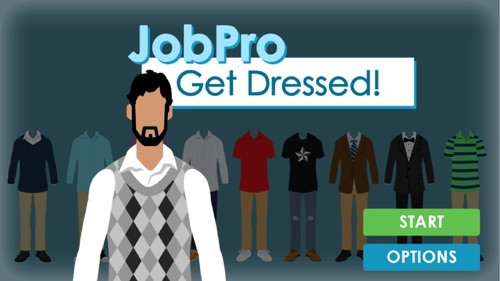
In JobPro: Get Dressed! you get a chance to dress for your interview based off of tips and your general knowledge of the company. Seems easy? Not so fast. There are various factors that go into picking out an outfit such as the role you are interviewing for and the atmosphere of the company.

Make sure you leave a lasting first impression in your interview. Prepare outfits for interviews with 14 different companies and 42 positions. After you make your selection you will receive detailed feedback about the outfit you chose and its compatibility with the position you were interviewing for.

iTuneshttps://itunes.apple.com/us/app/jobpro-get-dressed!/id1036998941?mt=8
Google Playhttps://play.google.com/store/apps/details?id=com.simcoachgames.getdressed
Amazon Marketplacehttp://www.amazon.com/Simcoach-Games-JobPro-Get-Dressed/dp/B015WUSKXQ

Sunday, October 11, 2015

JobPro: Get Prepared!

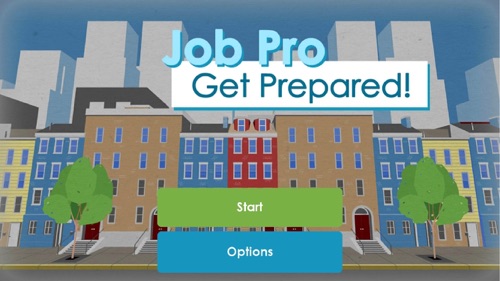
In JobPro: Get Prepared! you are put in the shoes of someone who has just landed an interview. Congratulations! Now it’s up to you to use the time you have to prepare and get to the interview on time. Prepare for your interview by researching the company and printing your resume or relieve stress by playing video games and exercising at the park. It’s up to you what you do with your time. Just remember, there is an interview waiting for you.


In JobPro, preparation is key. Navigate across 8 artistic environments like the coffee shop, park, and library where you engage in activities that affect your preparation and stress. Challenge yourself by completing all 3 difficulty levels. Your resources and time are limited with each increase in difficulty. See if you have what it takes be punctual, prepared, and professionally dressed when you arrive for your interview. Remember to get prepared in order to get hired!

iTunes: https://itunes.apple.com/us/app/jobpro-get-prepared!/id1036979990?mt=8
Google Play: https://play.google.com/store/apps/details?id=com.simcoachgames.getprepared
Amazon Marketplace: http://www.amazon.com/Simcoach-Games-JobPro-Get-Prepared/dp/B015WUR74E/

Saturday, October 10, 2015

JobPro: Get Hired!

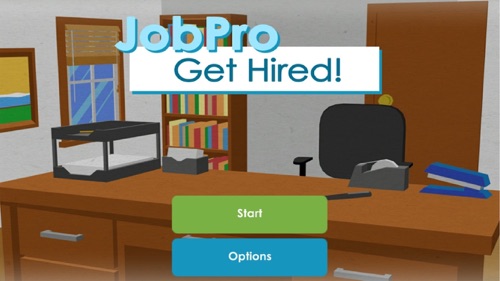
JobPro: Get Hired! is the third part of the JobPro trilogy and it puts you in the hot seat of an interview. Test your skills at more than just answering questions. In this game you need to control your avatar and keep him from nodding off, fidgeting, looking around the room, slouching, and much more.

Test your ability to address and fix these bad behaviors before the interviewer notices. After each interview check and see if you got the job. View your answers to the questions and also check out a detailed summary of how you did overall.

iTunes: https://itunes.apple.com/us/app/jobpro-get-hired!/id1036998640?mt=8
Google Play: https://play.google.com/store/apps/details?id=com.simcoachgames.gethired
Amazon Marketplace: http://www.amazon.com/Simcoach-Games-JobPro-Get-Hired/dp/B015WUS5TU/

Monday, September 21, 2015

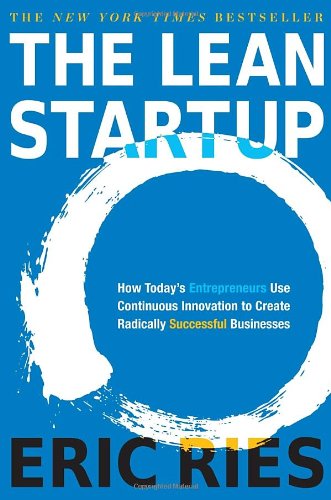
The Lean Startup by Eric Ries

The Lean Startup puts the scientific method into entrepreneurship, forcing entrepreneurs to take a hard look at their product/service and the value it brings (or does not bring). Author Eric Ries promotes testing every product feature with the target audience as fast and as often as possible. Through cohort analysis (looking at the results of a targeted group of users rather than the entire customer base) entrepreneurs are stared in the face by the cold hard facts of their value offering and not deceived by vanity metrics.

Author Eric Ries states a few times that he is out to debunk the entrepreneurial myth that a good idea and hard work trump all. Calculated risks, A/B testing, and failing fast seem to be Eric’s equivalent for working smarter, not harder. It’s a notion that is completely counter-intuitive to the American way, but it is a necessary one. Everyone hears the success stories of the 0.1% of entrepreneurs who hit the jackpot due to what seems like magic (though they claim it’s the result of having the right idea, at the right place and time). The stories that don’t get mass acclaim are of the other 99.9% of ideas that waste time, talent, and money because they were built on unproven assumptions.

Another interesting piece of Ries’ book is his emphasis on instilling the entrepreneurial mindset in any organization, no matter the size. He recommends doing this through the use of MVPs (minimum viable products). MVPs emphasize building the smallest scale version of a product/service as fast possible, and bringing it to market to gauge adoption. MVPs can be all smoke and mirrors or completely inefficient at their initial scale. The emphasis of an MVP is not to accrue revenue initially, it’s to test if people care enough about what you’re building to use it/pay for it.

Some of these points seem like common sense, but I can see how they get pushed to the side amongst all of the other pressures an entrepreneur faces. Someone in the traditional startup setting could receive financial backing for an idea early on, and depending on the source of funding, they may receive pressure to monetize as fast possible without knowing whether their product is valuable or not. Feeling pressure by the bottom line and overall user base (vanity metrics), the entrepreneur completely ignores more meaningful data.

Eric Ries uses proven logic and reason to address crucial business flaws. The Lean Startup is a must read for anyone in the business of developing new business.